
 Shopping Cart Home - Start Here
 Remote Controls for Radio Equipped Motors
 DIY Starter Kits for Window Shades
 DIY Starter Kits for Window Openers
 ZWAVE Blind & Shade Controllers
 How To Choose the Right Blind & Shade Motor
 Select tubular Motor (Comparison table)
 Choose RollerTrol Battery & Solar Motors
 DIY Roller Blind Motors - FAQ
 How To Insert Blind Motors & Attach Brackets
 Calculate your Blind or Shade fabric Weight
 Select Tube Size for Blind Motor
 How to Insert Blind Motors Into Tube
 How to Insert Blind Motors Into Tube with Adapters
 Attach Mounting Brackets - Standard + Mini Series
 Attach Mounting Brackets - MAXI Blind Series
 How To Set Up Radio Equipped Blind & Shade Motors
 Series P Radio Remote Control Motors
 Series G Radio Remote Control Motors
 Series R Radio Remote Control Motors
 BroadLink RF/IR Hub System for Motors
 How To Set Up Window/Skylight Openers
 Introduction: Window & Skylight (K Series)
 BroadLink RF/IR Hub System for Motors
 Z-Wave Interfacing for Shade & Opener Motors
 Wired Wall Switch Control of Window Openers
 How To Use Alexa With Our Motors & Window Openers
 How To Use BroadLink Phone App Hub With Our Motors
 How To Set Up ShadeSlider Skylight or Bottom-Up Blind
 How To Retrofit RV, Boat and Motorhome Blinds
 How To Set Up Non-Radio Motors
 Operation & Travel Limits of Non-Radio Motors
 Make a Simple DC Motor Reversing Switch
 How To Set Up ZWAVE Control
 ZWAVE Controller for G Series Radio motors
 ZWAVE Door/Window Opening Detection
 ZWAVE Motion Detector with Temperature Sensing
 Motorized Window Blinds & Shades
 Motorized Dual Window Shade
 Make Motorized Blackout Blinds
 Phone-Tablet-PC Control for Motorized Blinds
 Mini Motor for Existing Shade Retrofit
 Roman Shade Retrofit
 Make a Motorized Window Opener
 Blind & Shade Motors for RV & Boats
 Make Your Own Projector Screen
 Curtain Closer: Ultimate Home Theater
 Wireless Battery Operated Drapery Motor Kit
 Make a Motorized Bottom-Up Shade
 Make a Motorized Skylight Opener
 BroadLink RF/IR Hub System for Motors
 Why Buy From US?
 Background & Mission Statement
 Customer DIY Testimonials
 Site Map - Search All Pages
 Why Buy From US?
 RollerTrol Users Forum
 Contact Page
Our high quality DIY remote control RollerTrol™ DC tubular motors are perfect for making custom remote control window blinds and shades, skylight shades, projector screens, awnings, banners, conveyers or any application where you need a rotating tube.
The low voltage DC operating current is safe for children or adults, and you do not need to be an electrician to install these.
We hope the following information and specifications will help you make the right choice when selecting your tubing, but please feel free to contact us at any time if you have any questions.
The most important factors when choosing the right motor for blinds or other applications are drive size, lift capacity, and control options:In this article we will focus on the drive size and how it affects your choice of tube size.
We have two basic physical sizes of 12 volt motors: the standard series with a 35mm drive adapter, and the mini series with an 18mm drive adapter:
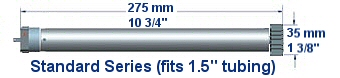
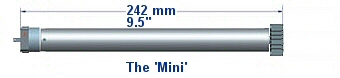
Please Note: our standard series (35 mm drive adapter) is designed to fit inside industry standard 1.5" tubing. If you purchase a shade with 1.5" tubing, the motor will simply slide into the tube, and the cut-outs on the drive wheel will lock to the splines inside the tube. The splines (grooves/slots) are usually used to lock the edge of the material in place.
Please Note:We are now also providing pre-made shades cut to size and mounted on 1.5" tubing, with a hem bar. Please feel free to contact us for a quote anytime.
Each model is available with and without built-in remote control. Units without remote control are typically used in situations where there is already a home automation system in place (see our home automation controllers for more info about this).
The standard series is designed to work in most situations with almost any window size where you want to install a motorized blind or shade with remote control. There are two models in this series, with different gearing and lift capacities: 6 lb (2.7 kg) @ 34 rpm and 12 lb (5.5 kg) @ 28 rpm.
The mini series, although slower, is designed to fit inside the cardboard roller typical of most retail rolller style shades that you may have already installed. The ability to retrofit existing shades with the 'mini' can save you a lot of money. Our 'mini' may be the smallest tubular motor available anywhere, and it has many other potential applications due to its small size.
We recommend aluminum tubing as a good choice for the roller material, although you can use cardboard, plastic and steel tubing if it suits your purpose. The following pertains to aluminum tubing, but the dimensions can be applied generally to other types of tube material. There are 3 important dimensions to consider (other than length):
OD (Outer Diameter)
WT (Wall Thickness)
ID (Inner Diameter)
Tubing is generally specified as OD, but the wall thickness can be different, producing a different ID.
Also, do not get confused by the difference between TUBING and PIPE. Tubing is generally used as a construction material (specified as OD) whereas pipe (specified as ID) is generally used to carry liquids and gas, and typically has a thicker wall than tubing. Pipe might actually be a better choice if you have a long span and want to minimize sag.
There is also special tubing available with a splined wall (eg. Rollease®) that our motors are also designed to work with. It is more difficult to obtain and more expensive than standard round tubing. Our standard series will fit perfectly in Rollease® 1.5" tubing.
You can use any type of tubing for your blinds, the only critical dimension is the ID (inside diameter) because this is what the drive adapter has to fit inside, and come into contact with (if a friction fit doesn't suffice, you can drill a hole and insert a screw to lock it).
Our motors use very standard tubing available at any metal provider or welding shop. However, it is not a problem to reduce the diameter of the drive adapter (file or grinder) to fit some other close size. It is also not a problem to build up the diameter with tape. For more info on motor insertion, see our article about how to insert tubular motors into tubing.
For the Standard series, the approximate designation for a metal tube supplier is:
1.5" tubing (6061 Aluminum Round Tube)
OD (Outer Diameter): 1 1/2" = 1.5" = 38mm
WT (Wall Thickness - typical): 1/16" = 0.065" = 1.7mm
ID (Inner Diameter for drive adapter): 1 3/8" = 1.37" = 35mm
For a quick solution, we have found that 1 1/4" EMT conduit (the type used for electrical wiring in your home) fits the Standard series perfectly, and can be found at any building supply store like Home Depot.
We recently made a roller shade for a family room, and we bought a 3 foot length of 1 1/4" black ABS plumbing drain pipe for about $3 at Home Depot, then we went over to Fabricland and bought some roller shade material for about $30.
We inserted one of our battery motors into the tube (filed the drive wheel down a bit), attached the fabric with some masking tape, assigned the motor to a channel on the remote, screwed it into the wall with our mounting brackets, and it was done. Works perfectly, even without a locking setscrew.
For wider shades we would recommend that you use 1 1/4" EMT steel pipe instead, if you have any concerns about sag.
For the Mini series, the approximate designation for a metal tube supplier is:
1.0" tubing (6061 Aluminum Round Tube)
OD (Outer Diameter): 1" = 26mm
WT (Wall Thickness - typical): 1/8" = 0.125" = 3.2mm
ID (Inner Diameter for drive adapter): 3/4" = 0.75" = 18mm
For a quick solution, we have found that thin wall 3/4" copper pipe (the type used for water pipe in your home) fits the Mini perfectly, although it is expensive.
For the Maxi series, the approximate designation for a metal tube supplier is:
2.5" tubing (6061 Aluminum Round Tube)
OD (Outer Diameter): 2.5" = 64mm
WT (Wall Thickness - typical): 1/8" = 0.125" = 3.2mm
ID (Inner Diameter for drive adapter): 2.3" = 60mm
For the Battery series, use the Mini or Standard series designations, depending on which one you choose.
It does not matter how long the tube is from a power perspective or bracket strength (they are very strong). What's important is the weight of the fabric and tensioner bar at the bottom. Our standard series motors have a lift capacity of 6 or 12 lbs, measured with 1.5" tubing. If you use a larger diameter, the speed will increase but the lift capacity will decrease.
Here are a few online references, but it will usually be a lot cheaper for you to buy it locally:
http://www.metalsupermarkets.com/catalog/ALUMINUM/TUBE_ROUND/6061T6
http://www.metalsdepot.com/products/alum2.phtml?page=rndtube&LimAcc=$LimAcc
http://www.speedymetals.com/c-8371-round-tube.aspx?pagenum=2
http://www.onlinemetals.com/merchant.cfm?step=2&id=71
Please note that all models with built-in radio use our multi-channel remotes and/or VERA web interface.Here is a motor comparison table to help you choose the right one for your purpose:
Tubular Motor Comparison Matrix: (*key specifications in yellow)
| Part Number |
Radio |
Lift lb/kg |
Drive OD in/mm |
Typical Tube OD in/mm |
Torque Nm |
RPM |
Volts | Idle Current (mA) |
Max Load (mA) |
|---|---|---|---|---|---|---|---|---|---|
| Standard Series - With Internal Battery (25mm housing diameter) | |||||||||
| TMKP-1-RB | Y | 12/5.5 | 1.37/35 | 1.5/38 | 1.5 | 32 | 12 | 0.07 | 1500 |
| Standard Series: (25mm housing diameter) | |||||||||
| TMDP-12-25-15-32-R | Y | 12/5.5 | 1.37/35 | 1.5/38 | 1.5 | 32 | 12 | 0.07 | 1500 |
| TMDB-12-25-7-28-NR | N | 12/5.5 | 1.37/35 | 1.5/38 | 1.5 | 28 | 12 | 0 | 1500 |
| HEAVY DUTY MAXI Series: (35mm housing diameter) | |||||||||
| TMDP-12-35-45-9-R | Y | 45/20 | 2.4/60 | 2.5/64 | 10 | 9 | 12 | 0.07 | 4000 |
| TMDG-12-35-45-9-NR | N | 45/20 | 2.4/60 | 2.5/64 | 10 | 9 | 12 | 0 | 4000 |
Making the Right Motor Choice:
The first step is to calculate the weight of your intended load. If your application is for shades, blinds, screens or any other project that uses fabric or some type of material on a roller tube, you may first want to read our article about how to calculate blind or shade material weight. Note that the length or weight of the roller tube has little effect on the motor requirements, but the diameter of your tube and the fabric or load weight does.
Once you have an idea of your load requirements and tube size, use the table above to select the right motor (mouse over the table cells for explanation of a particular parameter). You can also see more detailed information and further comparison information by clicking on the model number of the motor in the table. This will take you to the appropriate page in our tubular motor and automation product catalog.
We sincerely hope you enjoy using these advanced tubular motors; if you have any questions, please feel free to contact us at any time!